AS2, AS3, AS4 file transfers
Applicability Statement protocols are designed to provide a secure means of transferring data. The AS2, AS3 and AS4 versions each offer unique benefits and are tailored to specific situations based on business needs. It is important to understand the differences between these protocols to determine which is best for your business and your trading partners.

The AS (Applicability Statement) protocols

AS2, AS3 and AS4 refer to different versions of the Applicability Statement (AS) communication protocol, which is used to transfer data securely and reliably between trading partners.
The AS protocol was developed by the Organisation for the Advancement of Structured Information Standards (OASIS) to meet industry needs for secure and reliable data transfer. Versions AS2, AS3 and AS4 have been released over the years to meet the evolving needs of the industry.
AS2 protocol
AS2 (Applicability Statement 2) is a protocol specification used to transmit sensitive data reliably over the internet. AS2 encrypts messages sent to business partners and suppliers via HTTPS or the S/MIME standard. Data is protected by digital certificates and encryption standards while in transit. Digital certificates are used to authenticate trading partners and ensure that data can only be accessed by authorised parties.
Companies often choose AS2 over other file transfer protocols (such as FTP or SFTP) because of the ease with which the protocol helps meet regulatory compliance requirements. AS2 serves as the standard for EDI data transfer. It specifies how data is connected, delivered, validated and acknowledged.
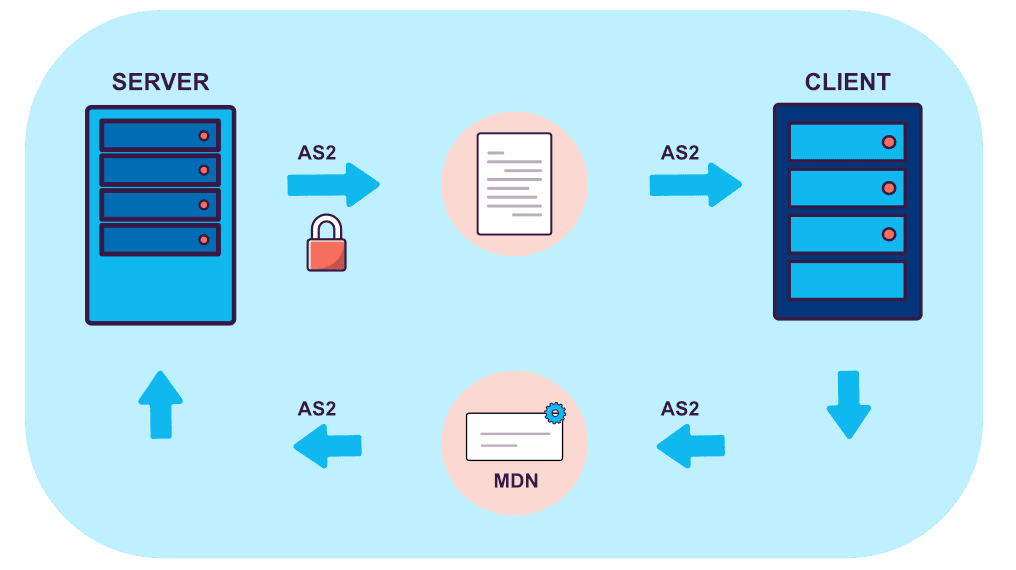
- End-to-end encryption/decryption
- The ability to send/retrieve files of any size and volume
- Sender and receiver digital signature authentication
- MDN (Message Disposition Notification) alerts to verify that messages have been successfully received and decrypted
- Confirmation of successful transfers
- Fast connectivity
- Ensures integrity by detecting document tampering
- AS2 can be used to transport any type of document. EDI X12, EDIFACT and XML formats are common, but any mutually agreed format can be transferred.
Why use AS2?
- AS2 is a universal file transfer protocol. It enables companies to implement EDI with partners around the world who have little EDI infrastructure. AS2 reduces transaction costs by using the web for EDI file transfers.
- This communication protocol saves time by eliminating the need to manually process orders, as well as errors by transforming manual processes into automated ones. AS2 complies with HIPAA compliance rules in the healthcare sector.
- AS2 can also be Drummond Certified. ‘Drummond Certified’ is a label awarded by Drummond Group, a third-party certification body, to any solution that can demonstrate interoperability between AS2 vendors. The certification is extensive and guarantees that the solution you use will enable you to integrate your AS2 trading partners.
AS3 protocol

AS3 offers the following additional benefits:
- End-to-end data encryption
- SSL encryption and hashing
- Confirmation of receipt or MDN
- Transaction details
- Transfer of multiple large files
- The ability to send any type of data
AS3 is a message standard which focuses on message formatting. Applications communicate XML and EDI data or other information using the FTP, SFTP, HTTPS, etc. protocols. These messages are structured using the standard S/MIME format. AS3 provides an additional level of security for data transmission through digital signatures and data encryption.
AS3 offers flexibility and security. It enables transfers to be received without repudiation (NPR), which provides the sender with legal proof of delivery (without alteration) and verification that the message received is identical to the one sent.

AS4 protocol
Applicability Statement 4, also known as AS4, is an open business-to-business (B2B) standard for securing and exchanging documents between companies using web services.
AS4 is designed to be a more flexible and scalable alternative to previous versions of AS. AS4 uses the ebXML (Electronic Business using eXtensible Markup Language) messaging protocol to transfer messages and files.
AS4 is frequently used for EDI integration projects. AS4 is also an exchange standard recommended by the European Commission for delivery and electronic invoicing projects. It offers a number of advantages, including:
- Use for both client and server (‘push’ and ‘pull’ actions
- Receipts/deliveries in the form of SOAP (Simple Object Access Protocol) messages with XML digital signatures
- Payload agnostic
- AS4 combines MIME and SOAP for message conditioning (AS2 is purely MIME-based)
- Security based on the WS-Security standard compared with the S/MIME specifications of AS2

Why AS4?
- Security: AS4 supports message security using mechanisms such as confidentiality, integrity and authentication. It uses X.509 certificates to establish the identity of the parties and enables encrypted messages to be exchanged.
- Traceability: The protocol offers advanced tracking and logging mechanisms to enable the traceability of messages exchanged. This makes it easier to audit and resolve problems relating to exchanges.
- Reliability: Applicability Statement 4 guarantees reliable message delivery using mechanisms such as acknowledgements and error recovery. It also enables commercial transactions to be managed, including confirmations and cancellations.
- Compliance: AS4 meets these security and traceability requirements, making it an attractive choice for organisations seeking to comply with these regulations.
- Routing: AS4 supports the routing of messages between trading partners. It can be configured to route messages according to different criteria, such as recipient address, message type or other metadata.
- Integration with other protocols: AS4 is designed to integrate with other protocols and standards commonly used in B2B exchanges, such as Simple Object Access Protocol (SOAP) web services and ebMS exchange profiles.
- Interoperability: AS4 is designed to promote interoperability between different stakeholders. It is based on widely accepted standards and technologies such as XML and Web Services, facilitating integration between enterprise information systems and enabling smoother data exchange.
- Certification: AS4 can also be Drummond Certified.
Use case AS2

GoAnywhere MFT
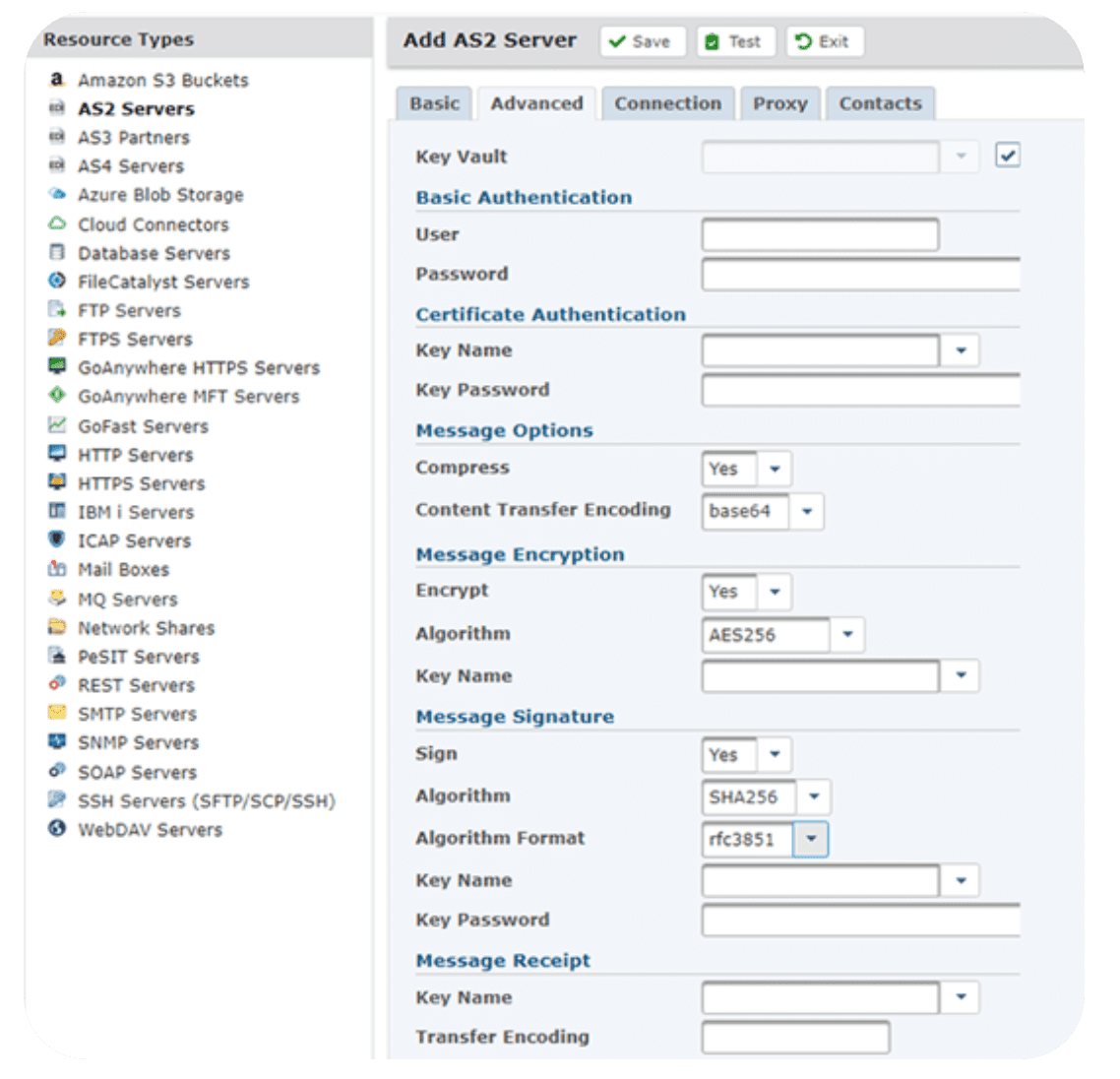
GoAnywhere MFT software enhances your AS2, AS3 and AS4 transfers. This Drummond-certified file transfer solution (AS2 and AS4) provides users with server capabilities via a simple, secure and scalable platform.
GoAnywhere MFT provides a browser-based interface for configuring and monitoring AS2, AS3 and AS4 file transfers and workflows. Each administrator can be assigned different permissions within GoAnywhere and have their own customised dashboards.
GoAnywhere MFT is not limited to one file attachment per AS2 message. You can attach multiple files to a message or use a variable to automatically attach files that meet your criteria.
The file transfer solution provides detailed audit reports of all AS2 transfer logs. You will find information such as the date, time, sender and content sent. The MFT solution makes it easy to create and manage certificates for your exchanges.
